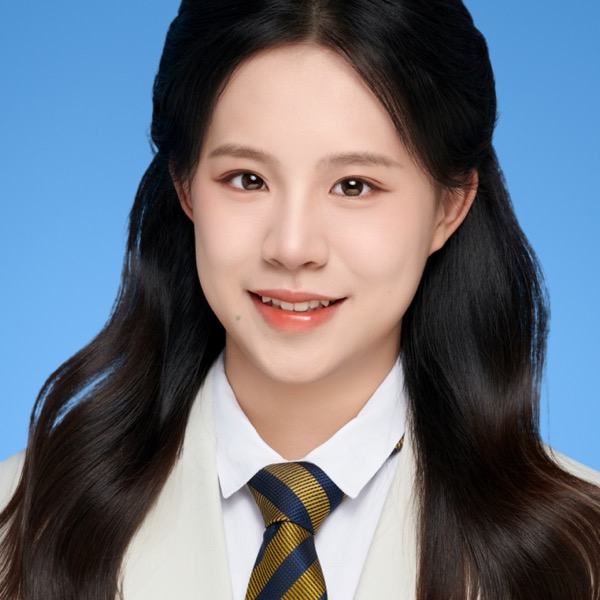
Hi there! I am Mujie Lin(林慕婕), an M.Phil. student in Computer Science at Peking University. Before that, I received my B.S. in Biotechnology from South China University of Technology, with a minor in Computer Science.
My research spans two complementary directions: large language models and scientific agents, focusing on post-training, evaluation, and scientific reasoning; and scientific foundation and generative models, with applications in biomolecular dynamics, protein and molecular design, and AI-driven drug discovery.
I am particularly interested in bridging foundation model reasoning and biomolecular modeling to advance reliable, verifiable, and AI-driven scientific discovery.
Research Interests
- Large Language Models and Scientific Agents
- Foundation model evaluation and post-training: LLM evaluation, capability-driven data synthesis, supervised fine-tuning, reinforcement learning, and evaluation-driven model improvement.
- Scientific reasoning and agentic intelligence: Scientific knowledge reasoning, tool-augmented problem solving, scientific agent post-training, and verifiable research workflows.
- Scientific Foundation and Generative Models
- Biomolecular dynamics: Spatiotemporal and spatio-spectral generative modeling, autoregressive and diffusion-based molecular dynamics generation, and conformational ensemble modeling.
- Protein and molecular design: Structure-conditioned generation, sequence–structure co-design, protein–ligand modeling, and dynamics-guided biomolecular design.
- AI-driven drug discovery: Molecular representation learning, property and phenotype prediction, and virtual screening for medicinal chemistry.
News
- 2026.10: BeziCast (co-first author work) accepted to NeurIPS 2026 as a poster — training-free diffusion acceleration via Tikhonov-stabilized Bézier representation forecasting.
- 2026.09: PhiFold (co-first author work) released on arXiv — dynamic protein design via physics-structured covariance modeling.
- 2026.09: OpenAI4S released on arXiv — an open-source scientific research agent with persistent execution and session-level provenance (code).
- 2026.06: SyntheticBench (work done during internship at Syneron Bio & KAUST Center of Excellence on Generative AI) accepted to Genomics, Proteomics & Bioinformatics (SCI, JCR Q1 TOP, IF = 13.9).
- 2026.05: BioDynaSpec (first-author work) accepted to ICML 2026.
- 2025.11: ProAR accepted to AAAI 2026.
- 2025.06: Contributed to MiniMax-M1 in the MiniMax Foundation Language Model Team.
- 2025.05: ADCNet published in Briefings in Bioinformatics (SCI, JCR Q1, IF = 8.7).
- 2025.01: SciAssess (work done during internship at DP Technology) accepted to NAACL 2025 Findings.
- 2024.05: MalariaFlow (first-author work) published in European Journal of Medicinal Chemistry (SCI, JCR Q1, IF = 6.4).
- 2023.11: FG-BERT (second-author work) published in Briefings in Bioinformatics (SCI, JCR Q1, IF = 8.7).
Selected Publications and Preprints
Tikhonov-Stabilized Bézier Representation Forecasting for Training-free Diffusion Acceleration
Lei Zhu#, Mujie Lin#, Ruochong Zheng, Guangyi Wang, Hao Li, Peng Jin, Chang Liu†, Jie Chen†
Training-free diffusion acceleration by forecasting output-proximal denoising representations along low-order Bézier trajectories, with Tikhonov-stabilized control-point fitting. Up to 4.79× speedup on FLUX.1 and 4.11× on HunyuanVideo.
PhiFold: Towards Dynamic Protein Design with Physics-Structured Covariance Modeling
Yutian Liu#, Mujie Lin#, Lanqian Zhang#, Meng Fan, Chang Liu†, Zhiwei Nie†, Siwei Ma†
[Paper]
Joint generation of protein backbones and their second-order dynamics via a compact, physically constrained covariance representation.
OpenAI4S: Code as Action, Science as Sessions
Gongbo Zhang, Hao Li, Yu Wang, Mujie Lin, Liuzhenghao Lv, Yicheng Mao, Yimi Wang, Jun Zhu, Minhan Tang, Zhengxiang Jiang, Yusong Wang, Jiayu Yao, Kunpeng Ning, Dawei Pang, Yonghong Tian, OpenAI4S Community, Yuyang Liu, Li Yuan
Open-source scientific research agent with a persistent runtime, append-only Action Ledger, and workspace checkpoints for inspectable, resumable, and reproducible long-horizon studies.
Mujie Lin, Yutian Liu, Yudi Guo, Yanzhen Hou, Yiheng Tao, Ruochong Zheng, Kaiwen Cheng, Xin Shan, Youdong Mao, Jie Chen
Spatio-spectral generative modeling for long-horizon protein dynamics, reducing trajectory error by over 60% on ATLAS.
ProAR: Probabilistic Autoregressive Modeling for Molecular Dynamics
Kaiwen Cheng, Yutian Liu, Zhiwei Nie, Mujie Lin, Yanzhen Hou, Yiheng Tao, Chang Liu, Jie Chen, Youdong Mao, Yonghong Tian
[Paper]
Probabilistic autoregressive generation of molecular dynamics trajectories with anti-drifting sampling for long-horizon stability.
MiniMax-M1: Scaling Test-Time Compute Efficiently with Lightning Attention
Aili Chen, Aonian Li, …, Mujie Lin, …, et al.
Open-weight hybrid-attention reasoning model. I built automated evaluation infrastructure and reasoning benchmarks for large-scale model iteration.
ADCNet: a unified framework for predicting the activity of antibody-drug conjugates
Liye Chen#, Biaoshun Li#, Yihao Chen#, Mujie Lin, Shipeng Zhang, Chenxin Li, Yu Pang, Ling Wang
A unified deep learning framework for antibody-drug conjugate activity prediction, integrating antigen, antibody, linker, payload, and DAR representations.
Mujie Lin, Junxi Cai, Yuancheng Wei, Xinru Peng, Qianhui Luo, Biaoshun Li, Yihao Chen, Ling Wang
A curated antimalarial activity prediction platform for multistage phenotypic drug discovery.
Uni-SMART: Universal Science Multimodal Analysis and Research Transformer
Hengxing Cai, Xiaochen Cai, Shuwen Yang, Jiankun Wang, Lin Yao, …, Mujie Lin, …, Guolin Ke
Multimodal scientific literature understanding for molecules, tables, and charts; featured as Hugging Face Paper of the Day.
Biaoshun Li, Mujie Lin, Tiegen Chen, Ling Wang
Functional-group-based molecular representation learning for transferable molecular property prediction, pertained based on ~1.45 million unlabeled drug-like molecules.
Honors and Awards
- Chinese National Scholarship, 2022-2023
- Challenge Cup National Competition, Grand Prize, jointly responsible
- National College Student Innovation Training Program, Outstanding Completion, project leader
Educations
- 2025.09 - now, M.Phil. student in Computer Science and Technology, Peking University
- 2021.09 - 2025.06, B.S. in Biotechnology, South China University of Technology
- 2022.09 - 2025.06, Minor in Computer Science, South China University of Technology
Internships
- 2025.02 - 2025.08, LLM Algorithm Intern, Foundation Language Model Team, MiniMax
- 2024.12 - 2025.03, Machine Learning Research Intern, Syneron Bio & KAUST Center of Excellence on Generative AI
- 2024.07 - 2024.08, Visiting Student, AI Computational Biology Lab, Westlake University
- 2023.07 - 2024.03, AI4S Innovative Algorithm Researcher Intern, DP Technology
Academic Service
- Journal reviewer: Scientific Reports, Bioinformatics, Molecular Diversity
- Conference reviewer: ACM MM 2026, NeurIPS 2026